 |
| Register at prairielab.com/immersion today! |

Wednesday, September 23, 2015
Celebrate Autumn on the Prairie!

Tuesday, September 1, 2015
Call for Entries: A NEW Biomimicry Scholarship for Emerging Professionals!

Biomimicry Chicago is once again proud to sponsor a scholarship to the upcoming Chicago Biomimicry Immersion experience at the Morton Arboretum, brought to you by our partners at Prairie Lab, LLC! Prize includes one seat at the October 17th workshop, a $225 value worth 4 CEUs.
Submission Guidelines
To enter, submit an original work that describes how you plan to integrate biomimicry into your chosen career. The original work can be anything of your choosing (a blog entry, short essay, photo, drawing, or video), but should include your response to the question: "What will I ask nature?"
In the contact form to the right, please enter your name, email, and add your age, profession, and the school or company affiliation in the message box. Submit all original works to biomimicrychicago@gmail.com by October 5th to be eligible to win. By submitting an original work, you grant Biomimicry Chicago the permission to post your work to our blog and social media.
Good luck and we are excited to see what you produce!
Not an emerging professional? No problem! Visit prairielab.com/immersion to learn more and be sure to enter promo code "BIOCHI10" for 10% off the cost of registration!
Monday, August 10, 2015
Back to School = Back to Nature!

Join our friends at #PrairieLab for the next in their seasonal biomimicry workshops and explore our native ecosystems while applying biomimicry methodology to your next design challenge.
BioBrainstorm! Emulating Nature’s Innovative Solutions for Sustainable Design
Morton Arboretum
Saturday, August 22nd
10:00am - 2:30pm
Enter promo code BioChi10 for 10% off the cost of registration and to support our network.
prairielab.com/immersion
Monday, July 13, 2015
Discovering the Prairie!
 |
| Immersive education via Prairie Lab, LLC |
Saturday, August 22nd.
Register today!
Monday, July 6, 2015
Take a #biomimicry & #biophilia walk THIS WEDNESDAY at the Lurie Garden!

We are following up our amazing AIA Chicago event "Bio-What?!?" with a tour of the Lurie Garden THIS WEDNESDAY, July 8th. Join us at 5:45pm as we discuss "The Science Behind the Beauty" and then head over to the Jay Pritzker Pavilion for the Grant Park Music Festival!
FREE to AIA members and $15 to all others, but space is limited, so register today!
http://www.aiachicago.org/eve…/the-science-behind-the-beauty
Wednesday, June 24, 2015
Nine Reasons Why Applying Biomimicry to Built Environment Projects is a Win-Win-Win!
 |
| Photo: Zlicovek, Shutterstock |
Biomimicry Chicago co-founder, Amy Coffman Phillips, was recently asked to contribute to the Biomimicry Institute's new blog, Asking Nature. Check out her thoughts on "Nine Reasons Why Applying Biomimicry to Built Environment Projects is a Win-Win-Win!"
"Designers in the building industry are continually looking for new and innovative ways to create beautiful, livable spaces that are environmentally responsible and resilient. Increasingly, those on the leading edge are looking to nature as a source of inspiration. Here are nine examples of how applying biomimicry in the context of the built environment can help designers, projects, and communities as they work to create naturally sustainable, inherently resilient spaces."Curious to learn more? Check out the next Chicago Biomimicry Immersive Workshop THIS SATURDAY! Enter promo code 'BioChi10' for 10% off the cost of registration!
http://biomimicry.org/next-design-innovation-built-environment-learning-nature/
Thursday, June 18, 2015
Announcing the WINNER of the Chicago Biomimicry Immersion Scholarship!
Congratulations to recent graduate Brian Cabinian on winning the Chicago Biomimicry Immersion Scholarship for June 2015! Brian impressed the jurors with his curiosity and clear articulation of how the field of biomimicry will improve his career path.
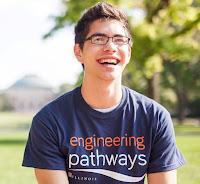

Brian Cabinian graduated the University of Illinois in May 2015 with a B.S. in Materials Science and Engineering and currently works at the Construction Engineering Research Lab in Champaign, Illinois on water treatment systems. In Fall 2015, he will be attending graduate school at the University of California - Santa Barbara to pursue a PhD in Materials Science.
A special thank you to jurors Peter Nicholson, Rachel Hahs, Amy Coffman Phillips, Michelle Halle Stern, and Joseph Clair for their help in selecting from an amazing group of candidates!
Don't forget to register for the next Immersion on Saturday, June 27th, and enter promo code 'BioChi10' for 10% off the cost of registration and to help support the work of Biomimicry Chicago!
Brian's winning essay:
Brian's winning essay:
How do you solve the world’s toughest engineering problems? Ask nature.
I wasn't really a nature lover as a child. I didn't like laying in the grass for too long, bugs gave me (and still kind of do) the heebee-jeebee's, and I practiced clarinet instead of playing outside when I went to visit my grandfather's farm. My disregard for nature shifted though after I discovered biomimicry. I first heard about the concept through one of Janine Benyus's TED talks and I became obsessed with this idea of how innovators like Joanna Aizenberg at the Harvard Wyss Institute were using the natural world to push out better, more efficient, stronger, sustainable products. With that, you couldn't stop me from imagining and searching for all sorts of ways that nature had bested man made technology.
What I did enjoy as a child and what I've thrived in later in life, however, is solving problems, which I think is why I ended up as an engineer - specifically a Materials Engineer. I work at the Construction Engineering Research Lab in Champaign, Illinois. Working on problems that will hopefully lead to technology that improves daily life is extraordinarily satisfying and as you solve each problem you begin to challenge yourself more and more. The greatest engineering challenge we face today is the challenge of sustainable living: how do we re-engineer our way of life, our society, and our technology, so that, as Elon Musk said in a recent keynote speech, we don't "try to win the Darwin Award." In other words: how do we stop using up our limited resources, stop driving away eco-diversity, and maintain the environment that sustains our species. As I've tossed and turned this problem around in my head, one solution sticks out more than any other: can we imitate the natural world to a point where we can integrate our lives in the boundaries of life's natural limits? I think Biomimicry supplies a hefty guide to many engineering challenges of our day and for that reason I hope to integrate this thinking into my future career.
As a materials engineer, I'm extremely interested in how we make, or synthesize, the products we find in our daily lives. Consider your cell phone: the microchips in there are etched and patterned and smoothed to make a device that lasts for a very long time. What's interesting about this process is that so much material and energy is input to create a product that cannot be reintegrated into the natural world. Thus, I want to understand how nature uses closed cycles to ensure that resources continue to be useable over and over again. The answer to this question applies not just to materials but to many other areas of engineering, such as waste water management, food supply lines, etc. It's this question and many others that I hope to explore through the Biomimicry Immersion program at the Morton Arboretum.
I wasn't really a nature lover as a child. I didn't like laying in the grass for too long, bugs gave me (and still kind of do) the heebee-jeebee's, and I practiced clarinet instead of playing outside when I went to visit my grandfather's farm. My disregard for nature shifted though after I discovered biomimicry. I first heard about the concept through one of Janine Benyus's TED talks and I became obsessed with this idea of how innovators like Joanna Aizenberg at the Harvard Wyss Institute were using the natural world to push out better, more efficient, stronger, sustainable products. With that, you couldn't stop me from imagining and searching for all sorts of ways that nature had bested man made technology.
What I did enjoy as a child and what I've thrived in later in life, however, is solving problems, which I think is why I ended up as an engineer - specifically a Materials Engineer. I work at the Construction Engineering Research Lab in Champaign, Illinois. Working on problems that will hopefully lead to technology that improves daily life is extraordinarily satisfying and as you solve each problem you begin to challenge yourself more and more. The greatest engineering challenge we face today is the challenge of sustainable living: how do we re-engineer our way of life, our society, and our technology, so that, as Elon Musk said in a recent keynote speech, we don't "try to win the Darwin Award." In other words: how do we stop using up our limited resources, stop driving away eco-diversity, and maintain the environment that sustains our species. As I've tossed and turned this problem around in my head, one solution sticks out more than any other: can we imitate the natural world to a point where we can integrate our lives in the boundaries of life's natural limits? I think Biomimicry supplies a hefty guide to many engineering challenges of our day and for that reason I hope to integrate this thinking into my future career.
As a materials engineer, I'm extremely interested in how we make, or synthesize, the products we find in our daily lives. Consider your cell phone: the microchips in there are etched and patterned and smoothed to make a device that lasts for a very long time. What's interesting about this process is that so much material and energy is input to create a product that cannot be reintegrated into the natural world. Thus, I want to understand how nature uses closed cycles to ensure that resources continue to be useable over and over again. The answer to this question applies not just to materials but to many other areas of engineering, such as waste water management, food supply lines, etc. It's this question and many others that I hope to explore through the Biomimicry Immersion program at the Morton Arboretum.
Subscribe to:
Posts (Atom)