Wednesday, April 15, 2015

Image and article by Amy Coffman Phillips of The B-Collaborative (cross posted)
On a beautiful day when the sun is shining brightly, have you ever asked yourself, "how does nature optimize energy use?" Do plants dig miles below the earth's surface to pump up fossil sunlight, or does life use the abundant rays that beam to the surface every day? Does energy production in nature result in wasteful by-products or does it actually create conditions conducive to life? What can our built environment learn by asking these questions?

Discover answers to this and more at the Chicago Biomimicry Immersion, starting April 25th at The Morton Arboretum! Be sure to enter the promo code "BIOCHI10" for 10% off the cost of registration! www.prairielab.com/immersion.

Thursday, April 9, 2015

How does nature manage stormwater?

Image and article by Amy Coffman Phillips of The B-Collaborative (cross posted)
On a stormy day like today, we remember that water - life giving resource that it is - can cause big problems for the built environment! Maybe you are worried about your basement flooding. Or that your car will get stuck as flash floods cover roadways. Maybe you worry about water infiltrating your building, damaging finishes and inviting mold. The question we must ask is: are these problems inherent in the process of development or are they signs that we are managing stormwater incorrectly? 

Through biomimicry, we can find innovative solutions to this challenge by asking the question: "how does nature manage stormwater?"

As an architect, one of my primary responsibilities is to "keep water out" of buildings. Often, that means finding ways to accelerate the flow of water off the roof and away from the site. We do this with impermeable surfaces, downspouts, drainage channels, drain tile, and much more. The goal is to get water off and away as soon as possible, treating it as a waste product. But in nature, the strategy is the opposite of acceleration, but to slow the flow. Water is slowed in a many ways at a variety of scales. 

Let's think like a forest. 

Canopy trees are the first defense: slowing the fast moving water that falls from the sky and breaking it up into smaller droplets. Then understory trees, shrubs, and ground cover further serve to break apart water drops and slow the flow until they fall to the soil and are readily absorbed by spongy soil architecture. Excess water that is not readily absorbed runs off but is impacted by logs, twigs, rocks, and other obstructions that serve to further slow this acceleration. The result is that only a very small percentage of the water that falls from the sky actually runs off to streams and rivers in intact ecosystems. 

What a difference from our built environment where over half of the water that falls on site is wasted, taking soil and pollution along with it to clog waterways.  
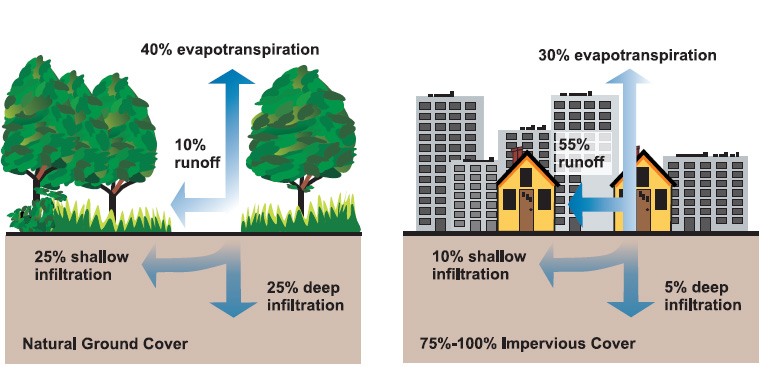
Image courtesy of the EPA via Wikipedia, depicting two different types of built environment. In intact ecosystems, the amount of runoff is many times even less, although it varies by ecosystem type and local conditions. 
Fortunately, architects, planners, city officials, and politicians are realizing that in the process of developing our cities, we have destroyed native ecosystems and the services they provided. Through biomimicry and the "Genius of Place" process, we can begin to reverse this situation and the negative impacts we have created for ourselves. 

It's time to rethink the paradigm of stormwater as a waste product and look to nature for inspiration to make our buildings like trees, our cities like forests.

Discover innovative solutions to this and other challenges at the Chicago Biomimicry Immersion, starting April 25th at The Morton Arboretum! Be sure to enter the promo code "BIOCHI10" for 10% off the cost of registration!

Wednesday, March 4, 2015

Chicago Biomimicry Immersion - 2015!


Biomimicry Chicago has partnered with Prairie Lab, LLC, to offer our followers discounted registration for this year’s Biomimicry Immersion: Chicago-Style! Four experiences, each as unique as our region. Visit prairielab.com/immersion to learn more and register. Be sure to contact us at biomimicrychicago@gmail.com or on twitter @biomimicrychi to receive 10% off the cost of registration!


Thursday, February 12, 2015

Permaculturists + Biomimics Team up!

We're kicking off the Global Biomimicry Design Challenge: Food Systems in the Chicago area with a potluck design charrette! Join our favorite permiculturists at The Resiliency Institute in Naperville as they explore how our urban streetscapes can work like food forests through biomimicry! Next Friday, Feb 20th, at 6:30pm. Learn more here!

challenge.biomimicry.org

Thursday, January 15, 2015

Upcoming Event: AuthentiCity!

Amy will be speaking at the following event: please join us to learn more about how we can design more sustainable, resilient cities by looking to the Genius of our Place! RSVP here!

5th Annual
Urban Innovation Symposium:

AuthentiCity
YOU'RE INVITED
Friday, January 30, 2015

PLEASE RSVP
to participate in the exchange of innovative planning methods and ideas that create authentic city spaces and enliven urban life from the ground up!


This two-part event will feature presentations and panel discussions with local strategists who foster places that maintain cities' and neighborhoods' cultural and environmental identities.

During the daytime session, from 9:00 AM - 1:00PM at Gallery 400 in UIC's Art and Exhibition Hall,professionals from around the region provide insight into cutting-edge ideas in physical planning, design, housing, and economic development.  CUPPA Dean Michael Pagano will be headlining as our keynote speaker to talk about the Obama Library proposal on UIC's campus.  Rounding out the daytime section will be a panel of urban planners who take to blogging as a way to advocate their points of view, moderated by UIC professor Charles Hoch.

At the evening event, from 7:00 PM - 10:00 PM at the Royal George Theatre's Black Box Theaterspace, urban professionals deliver presentations in the fast-moving, visually-oriented PechaKucha®  (PK) format in an informal atmosphere, encouraging attendees to get to know each other and enjoy complimentary appetizers and cash bar.
 
Open and free to the public.

RSVP | DAYTIME SESSION
RSVP | EVENING SESSION


For more information, please visit www.UPPSA.org or e-mail us aturbaninnovatesym@gmail.com